What you’ll Read in This Article
In this article, we answer the question what is French press coffee? And explore its characteristics. We’ll teach you how to brew French press coffee step by step, emphasizing the grind size, key to success. We’ll also compare French press and filter coffee in terms of flavor and body, and finally discuss the best bean combinations for French press coffee along with its health benefits.
What Is French Press Coffee? Full Immersion Brewing
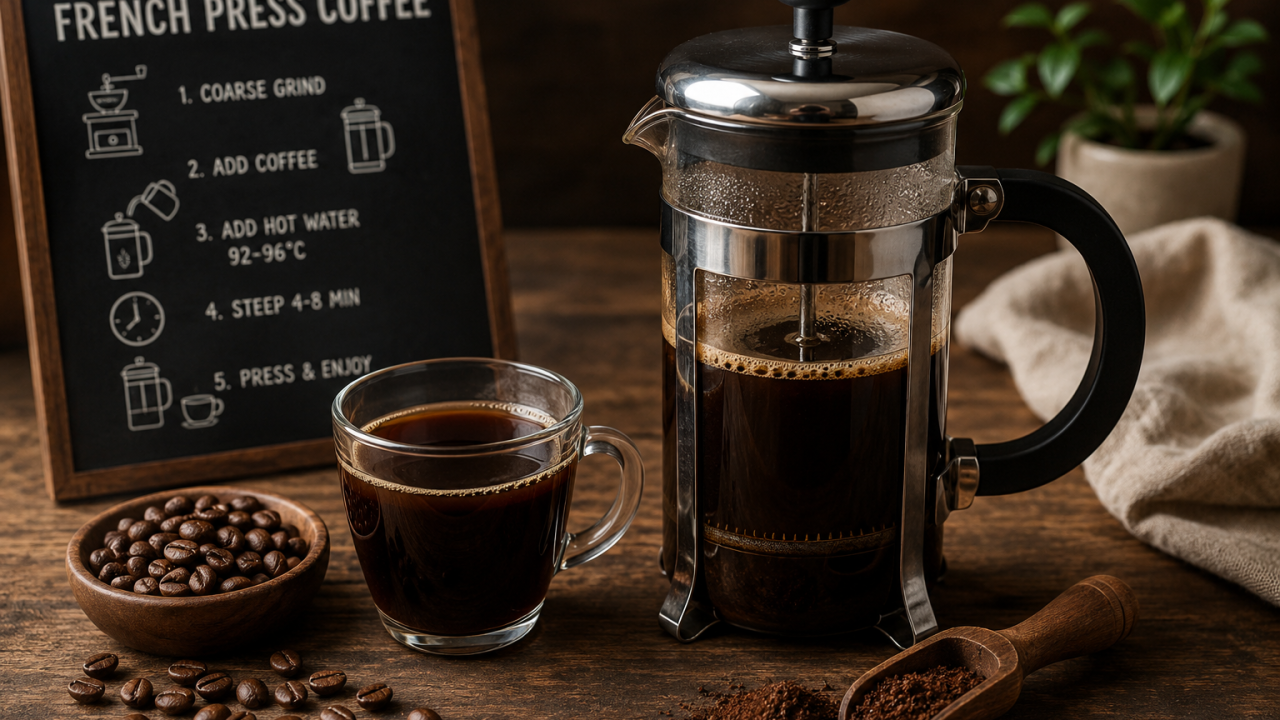
French press coffee refers to a brewing method in which ground coffee is steeped directly in hot water and then separated from the drink using a metal filter in the French press. This is one of the simplest and oldest home-brewing methods for coffee.
Characteristics of French Press Coffee: Heavy Body and Natural Oils
- Heavy body: Because the French press uses a metal filter (unlike paper filters), natural coffee oils and fine particles remain in the cup. This gives French press coffee a thicker, oilier, and richer body.
- Full flavor: Preserving natural oils ensures a strong, complete taste and aroma.
- Longer brew time: Brewing usually takes 4–8 minutes.
How to Brew French Press Coffee: The Key Is the Grind
Brewing French press coffee is simple, but grind size is critical.
Grind Size: Coarse and Even
- The grind must be coarse and uniform. If too fine, particles pass through the metal filter, creating a muddy residue.
- Hot water: Boil water, then let it rest for ~30 seconds until it reaches 92–96°C.
- Immersion: Add coarse-ground coffee to the French press and pour hot water gently over it.
- Steeping: Place the lid on but don’t press the plunger down yet. Let it steep for 4–8 minutes.
- Pressing: Slowly push the plunger down to separate the grounds, then serve immediately.
French Press vs. Filter Coffee: Understanding Body and Acidity
The difference between French-press coffee and drip or pour-over coffee (which use paper filters) lies in the quality of extraction and filtration:
|
Feature |
French Press |
Filter Coffee (Pour Over/Drip) |
|
Method |
Immersion |
Percolation |
|
Body |
Heavy, oily, rich |
Light, clear, more watery |
|
Acidity |
Less pronounced |
Brighter, clearer notes |
|
Filter |
Metal (allows oils) |
Paper (removes oils) |
Best Beans for French Press and Its Benefits
A wide range of bean origins and roast profiles can be used to brew an excellent French-press coffee.
Best Bean Combination
Since this method highlights complex flavors, Arabica beans with a medium roast are ideal. They balance acidity and bring out fruity and nutty notes.
Benefits of French Press Coffee
French press coffee shares the general benefits of coffee (focus, antioxidants). Additionally, because it retains natural oils, it contains cafestol and kahweol, compounds that may temporarily raise cholesterol but also have anti-inflammatory properties.
Conclusion: French Press Coffee, A Rich Flavor Experience
French press coffee is a simple yet effective way to brew coffee with a heavy body and maximum flavor retention. By using the right coarse grind and following the brewing steps carefully, you can enjoy a strong, flavorful cup that stands out distinctly from filter coffee.
Frequently Asked Questions (FAQ)
- Why does French press coffee turn cloudy or muddy?
Because the grind was too fine, allowing particles to pass through the metal filter and settle in the cup.
- Does French press coffee have more caffeine than espresso?
Per full cup, yes, due to longer water contact. However, espresso is more concentrated per shot.
- How can I reduce sediment in the cup?
Use coarse grind and serve immediately after pressing. Don’t leave the coffee sitting in the press.