What you’ll read in this article:
In this guide, we introduce the cortado, a Spanish coffee with a unique structure. We’ll cover its history and fundamentals, explain the differences between cortado, latte, cappuccino, and other popular drinks, and teach you how to prepare cortado at home with the precise milk-to-coffee ratio to fully enjoy its rich flavor.
What Is Cortado? A Spanish Word Meaning “Cut”
The cortado is a classic Spanish coffee whose name comes from the verb cortar, meaning “to cut” or “to dilute.” In a cortado, steamed milk (not foamed) is used to “cut” or balance the acidity and intensity of espresso. Compared to lattes and cappuccinos, cortados are much smaller in volume, focusing on showcasing the flavor of the coffee.
Milk-to-Coffee Ratio: Simplicity in Balance
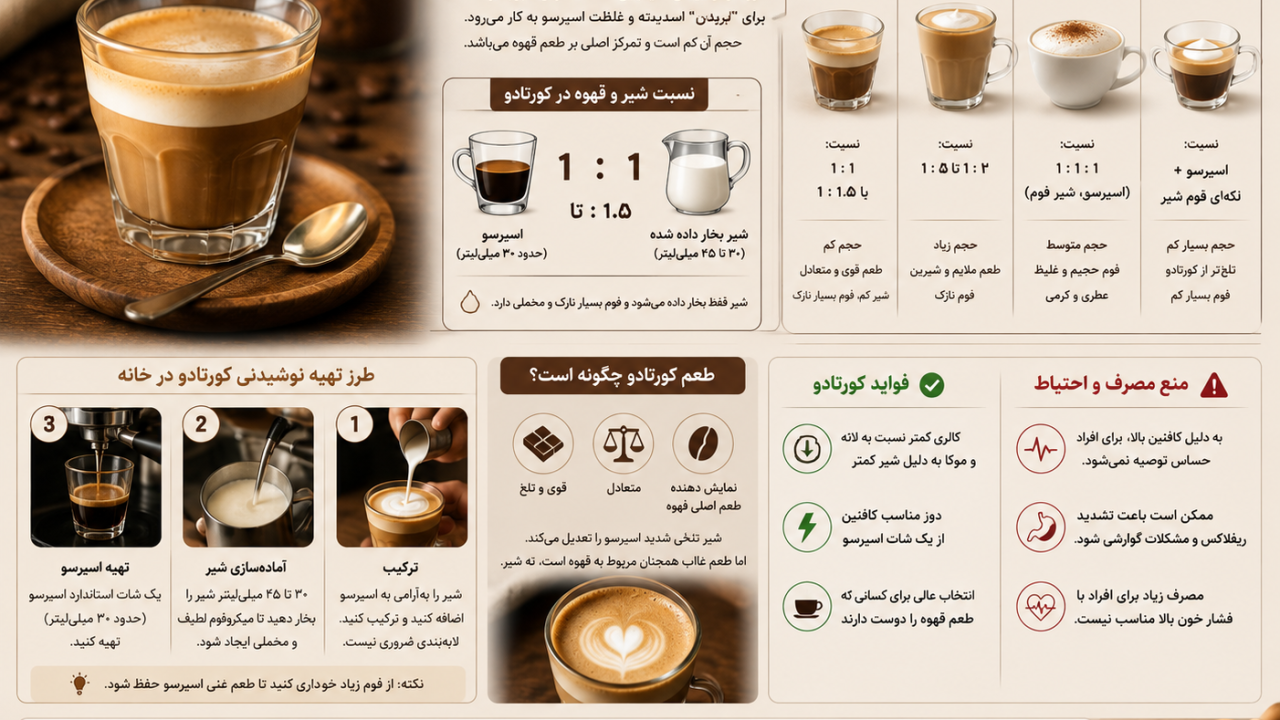
The essence of cortado lies in its simplicity and nearly equal ratio of milk to espresso:
- Ratio: Typically 1:1 or at most 1:1.5 (one part espresso to one–one and a half parts steamed milk).
- Milk: The milk is lightly steamed, producing a thin, velvety micro foam. It should not be overly foamy, so the bold coffee flavor remains dominant.
Differences Between Cortado, Latte, Cappuccino, and Macchiato
Cortado vs. Latte and Cappuccino
- Latte & Cappuccino: Larger in volume, with milk playing a major role. Cappuccino has thick foam, latte has thin foam, but both are sweeter and milkier than cortado.
- Cortado: Stronger and more bitter due to less milk, ideal for those who want to taste espresso clearly but with slight smoothness.
Cortado vs. Macchiato
- Espresso Macchiato: Made with just a small spot of milk foam, much more bitter than cortado.
- Cortado: Contains more milk, offering a balanced flavor where milk’s mild sweetness softens espresso’s acidity.
How to Make Cortado at Home
Although you need an espresso machine, the process is simple:
- Prepare Espresso: Brew one standard shot (about 30 ml).
- Steam Milk: Steam 30–45 ml of milk, ensuring no thick foam forms-only silky micro foam.
- Combine: Gently pour the milk into the espresso. Unlike latte macchiato, layering isn’t necessary; the goal is a smooth blend.
What Does Cortado Taste Like?
Cortado highlights the character of coffee beans. Its flavor is strong, bitter, yet balanced. The milk softens espresso’s sharp bitterness, but coffee remains the dominant taste.
Benefits and Limitations of Cortado
- Benefits: With less milk, cortado has fewer calories and sugar compared to lattes or mochas. A single shot of espresso provides a quick, strong energy boost.
- Limitations: Due to its concentrated coffee content, cortado isn’t recommended for people highly sensitive to caffeine or those with severe acid reflux.
Conclusion: Cortado, a Choice for Coffee Enthusiasts
With its balanced 1:1 ratio, cortado bridges the gap between pure espresso bitterness and the sweetness of milkier drinks like lattes. Understanding its differences and preparation method allows you to enjoy the authentic flavor of quality espresso in perfect harmony.
Frequently Asked Questions (FAQ)
- Can cortado be made with cold milk?
Traditionally, cortado is served hot with steamed milk. However, modern cafés also serve iced versions called “Iced Cortado.”
- What is a ristretto, and can it be used for cortado?
Ristretto is a shorter, more concentrated espresso shot. Yes, using ristretto in cortado creates a stronger, more intense flavor preferred by some coffee lovers.
- Why cortado is usually served in small cups?
Because of its small volume and espresso focus, cortado is typically served in small glass cups (gibraltar) or ceramic cups to preserve temperature and highlight its concentrated nature.