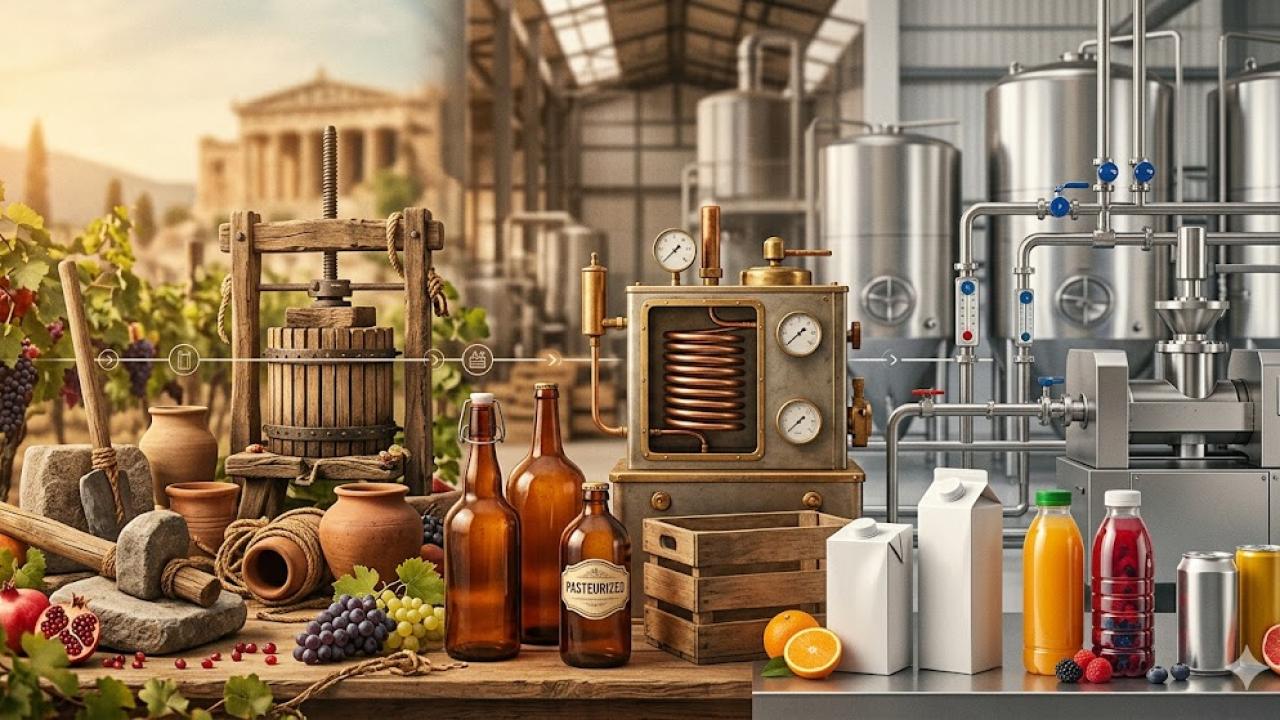
The juice industry has evolved throughout history from a simple household process in ancient times into a multi-billion-dollar global business. Its major turning point occurred in the late 19th century with the discovery of pasteurization, and later in the mid-20th century with the invention of aseptic packaging. These advancements made it possible for beverages that once spoiled within hours to be transported to the farthest parts of the world while preserving their nutritional value.
The evolution of this industry reflects the advancement of human knowledge in microbiology, mechanical engineering, and food chemistry. From pressing grapes in ancient civilizations to the use of high-pressure processing (HPP) technologies in modern factories, the objective has remained the same: extracting the flavor and nutrients of nature and preserving them. In this article, we take a journey through history to know the pioneers of this industry.
What Are the Ancient Origins of the Juice Industry?
In ancient times, juice consumption was largely limited to harvest seasons and local regions. The earliest evidence of large-scale juice production dates back to Mesopotamian civilizations and Ancient Egypt, where primitive stone presses were used to extract juice from grapes and pomegranates. At that time, due to the absence of preservation technologies, most juices were either consumed immediately or converted into wine or vinegar for longer storage.
During the Middle Ages, juices were primarily used for medicinal purposes. Herbalists used citrus extracts to treat diseases such as scurvy (vitamin C deficiency), without yet understanding the scientific nature of vitamins. This era is referred to as the “pre-industrial” stage, in which no production standards existed.
How Did Louis Pasteur’s Discovery Transform the Juice Industry?
In 1864, Louis Pasteur discovered that mild heating of liquids could eliminate spoilage-causing bacteria without completely destroying the product’s flavor. This discovery laid the foundation of the modern juice industry. Prior to this, bottling juice was practically impossible due to rapid fermentation and bottle explosions.
The first person to apply this knowledge commercially was a dentist named Thomas Welch in 1869. By using pasteurization, he produced non-alcoholic grape juice for use in church ceremonies. This success demonstrated that juice could be marketed as a packaged and shelf-stable product, leading to the birth of the first official juice brands.
Early Attempts to Commercialize Orange Juice in the 19th Century
In the late 19th century, with the expansion of railway networks in the United States and Europe, efforts were made to transport fresh orange juice from Florida farms to major cities. However, due to the lack of advanced refrigeration systems, most shipments spoiled. This challenge prompted engineers to seek ways to reduce volume and extend shelf life, ultimately leading to the early concept of concentrated juice production.
What Was the Impact of World War II on Fruit Concentrate Technology?
World War II was one of the greatest technological drivers in the history of the juice industry. The United States military sought a way to supply soldiers with vitamin C on the front lines, but transporting heavy bottles of juice was impractical. This urgent need led to the invention of vacuum evaporation processes.
Scientists discovered that by removing water at low temperatures (under reduced pressure), a concentrated extract could be produced while preserving the fruit’s properties. This product, known as fruit concentrate, had a much smaller volume and could be reconstituted by adding water at the point of consumption. After the war, this technology transitioned to civilian use and made juice consumption a daily habit in households.
Why Did Militaries Pursue Concentrated and Shelf-Stable Juices?
The primary reasons were logistics and space efficiency. One gallon of concentrate could be converted into seven gallons of juice, representing a 700% saving in transportation space. Additionally, frozen concentrates were among the first products to establish the concept of the “cold chain” on a large retail scale.
What Role Did Tetra Pak Play in Transforming Juice Distribution?
In 1951, Tetra Pak revolutionized the industry by introducing multilayer aseptic packaging, an innovation even more impactful than pasteurization. This technology allowed pasteurized juice to be packaged in a completely sterile environment in cartons composed of paperboard layers combined with aluminum and polyethylene.
The result was that juice could remain shelf-stable for up to one year without refrigeration. This invention significantly reduced distribution costs by eliminating the need for refrigerated transport and storage. It also enabled juice distribution in tropical and underdeveloped regions with limited electricity infrastructure. Today, most global market products owe their existence to this innovation.
Impact of Aseptic Packaging on Vitamin C Stability over Time
In a scientific experiment conducted at an agricultural sciences university, two identical orange juice samples were evaluated: one stored in a transparent glass bottle and the other in Tetra Pak (aseptic) packaging. Both were stored at 25°C.
Observations:
- Glass bottle sample: Due to light penetration and oxygen ingress through the cap, approximately 40% of vitamin C was oxidized after 30 days, and the product’s color shifted toward brown.
- Tetra Pak sample: The aluminum layer completely blocked light and oxygen. After 30 days, vitamin C loss was less than 5%, and the product’s flavor and color were fully preserved.
Evolution of Extraction Technologies: From Manual Presses to Modern Cold Press Systems
In recent decades, the industry focus has shifted from “mere shelf life” to “maximum quality preservation.” Traditional hydraulic presses have been replaced by high-speed centrifugal systems and falling film evaporators. However, the most significant recent advancement is the emergence of Cold Press technology.
In this method, no heat is applied to the fruit, and extraction is achieved using extremely high pressure. For preservation, instead of heat, HPP (High Pressure Processing) technology is used, which destroys bacteria through pressure while maintaining aroma molecules and vitamins intact.
Future Trends: Functional and Smart Beverages
The future of the juice industry lies in integration with biotechnology. Manufacturers are moving toward “functional drinks” enriched with probiotics, specific vitamins, and plant extracts. Additionally, reducing sugar content and replacing it with natural sweeteners such as stevia addresses global health concerns.
Artificial intelligence is also entering the supply chain, predicting optimal harvest times to achieve the highest Brix levels. The industry of the future will formulate each bottle of juice based on consumers’ biological needs while minimizing environmental impact.
Conclusion
The history of the juice industry reflects a continuous effort to overcome the perishability of nature. From Welch’s first pasteurized bottles to today’s intelligent packaging systems, a long journey has been undertaken to make health accessible. Today, technology not only ensures shelf life but also preserves the true taste and properties of fruit. Conscious consumer choices will drive the next wave of greener and healthier innovations in this industry.
FAQ – Frequently Asked Questions about the History of the Juice Industry
- What was the first industrial juice product?
The first commercial product was pasteurized grape juice produced by Thomas Welch in 1869. - Why was World War II important for this industry?
The need to supply soldiers with nutrition led to the large-scale development of concentrate production technology. - When did Tetra Pak enter the industry?
Its first packaging solutions were introduced in the early 1950s and became a global standard in the 1960s. - What was the main purpose of developing concentrate?
To reduce transportation costs by removing excess water and increasing shelf life. - What is pasteurization?
A process of heating liquids to eliminate pathogenic microorganisms, invented by Louis Pasteur. - How does Cold Press differ from traditional methods?
It does not use heat, therefore preserving aroma, flavor, and vitamins much more effectively. - Who first used glass bottles for juice?
Thomas Welch was the first to pasteurize and market grape juice in glass bottles. - What role did vitamin C play in this industry?
Preventing scurvy was a major driver for developing preservation methods for citrus juices. - What does aseptic packaging mean?
Packaging a sterile product in sterile containers within a sterile environment, eliminating the need for refrigeration. - Where is the future of the juice industry heading?
Toward personalized, functional beverages with highly controlled sugar content.