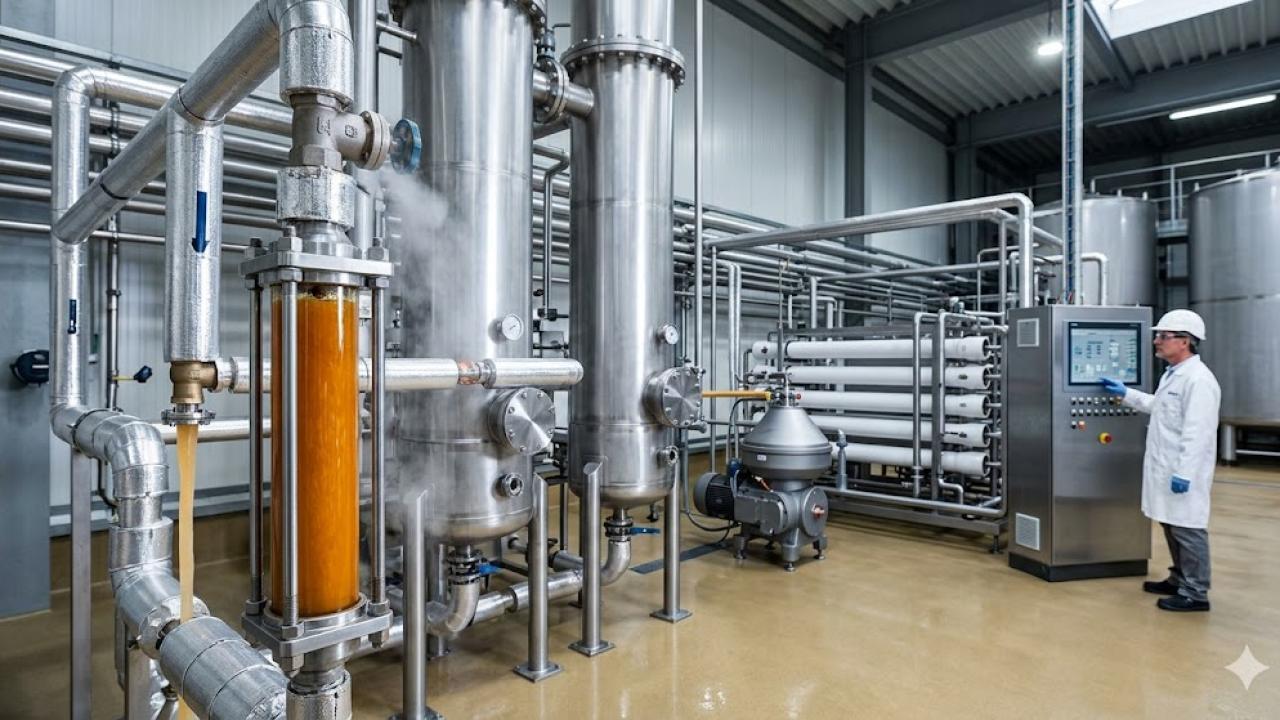
Fruit concentrate is essentially fruit juice from which most of the water has been removed through physical processes to reduce its volume and weight. This process is typically carried out using vacuum evaporators, enabling the production of a dense extract with extended shelf life while minimizing damage to nutrients.
Fruit concentrate is the backbone of the modern beverage industry. By removing excess water, it significantly reduces transportation costs and allows access to seasonal fruits year-round. Contrary to common perception, when produced correctly, concentrate retains a large portion of the fruit’s essential minerals and vitamins, which are restored during the reconstitution stage by re-adding water.
Why Is Fruit Concentrate Production Necessary in the Food Industry?
Fruit concentrate production is both an economic and technical necessity due to its microbiological stability and ease of storage. Removing water drastically limits the activity of bacteria and yeasts while reducing the product’s weight to approximately one-sixth of its original mass, facilitating international transportation.
In addition to logistical advantages, this process enables manufacturers to maintain consistent flavor and concentration in their final products. While fresh fruits vary in taste across seasons, concentrate acts as a standardized raw material that ensures consistent quality.
Initial Preparation and Juice Extraction
The first stage involves washing, sorting, and crushing the fruit to prepare it for juice extraction. After passing through chlorinated washing systems, the fruit is pressed using industrial presses to obtain raw juice (crude extract).
At this stage, the juice contains a significant amount of suspended particles, pectin, and tannins that cause turbidity. Therefore, it is immediately transferred to processing tanks for further treatment. Maintaining low temperatures at this stage is critical to prevent oxidation of phenolic compounds.
The Role of Enzyme Treatment in Clarification
Enzyme treatment involves adding pectinase enzymes to the juice to break down pectin structures. Pectin is the primary cause of viscosity and cloudiness in juices such as apple and grape.
By breaking down pectin, filtration becomes faster and more efficient, resulting in a clear product with a bright, transparent appearance.
How Concentration and Evaporation Are Performed
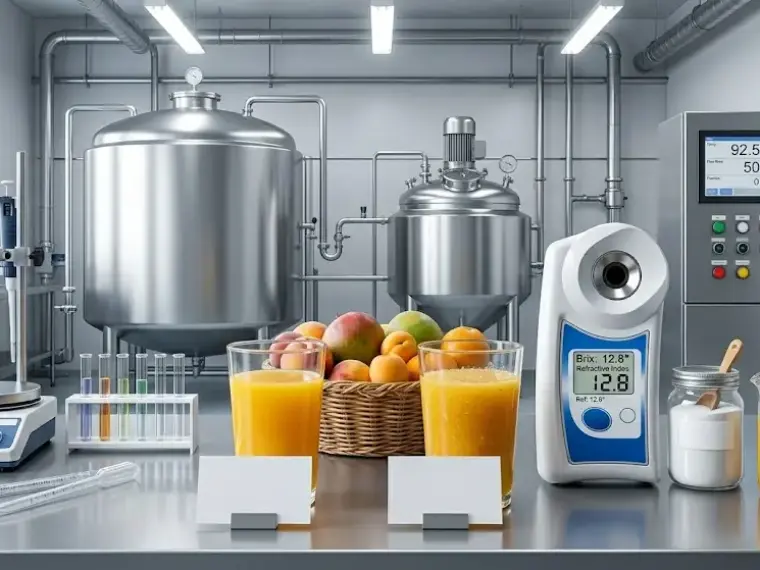
Concentration is the core stage of the process and is typically carried out in evaporators. In these systems, juice is heated under vacuum conditions, allowing water to evaporate at relatively low temperatures (around 50–60°C). This prevents degradation of vitamins and caramelization of natural sugars.
During this process, the juice passes through multiple evaporation stages until it reaches the desired concentration. The final product contains a high level of soluble solids, which is controlled using Brix measurement. This method ensures long shelf life without the need for chemical preservatives.
Why Aroma Recovery Is Essential
When juice is heated, volatile aromatic compounds are lost along with evaporated water. Modern concentrate production systems include aroma recovery units, which capture and condense these vapors to extract the fruit’s natural essence.
This recovered aroma is reintroduced during packaging or reconstitution to preserve the authentic smell and flavor of the fruit.
Modern Filtration and Separation Methods
After enzyme treatment, the juice must be thoroughly clarified. Instead of traditional filter presses, modern production lines use ultrafiltration systems, which remove even micron-sized particles and prevent sediment formation in bottled beverages.
High-speed centrifuges (separators) are also used to remove heavy particles before the evaporation stage. This high level of clarification distinguishes clear concentrates from fruit purees, where fiber is intentionally retained.
Changes in Vitamin C during Thermal Processing
In a controlled study conducted in an industrial R&D unit, vitamin C levels were measured at three stages:
- Fresh juice: 45 mg per 100 ml
- After vacuum concentration: only about 12% degradation (reduced to ~39 mg) due to low processing temperature
- After 6 months of storage: up to 85% of vitamin C retained in aseptic packaging
These results show that proper processing preserves a significant portion of sensitive nutrients.
What Is Reconstitution?
Reconstitution is the process of adding back exactly the same amount of water that was removed during concentration, restoring the product to its original state as 100% fruit juice.
The ratio of water to concentrate must be precisely controlled so that the final Brix level matches that of the original natural juice. In addition to purified water, recovered aroma compounds are also added.
If performed correctly, the final product is legally classified as “100% juice.” Importantly, no sugar, color, or preservatives are added during standard reconstitution.
How Are Quality and Brix Measured?
The quality of fruit concentrate is evaluated using two main parameters: Brix level and acidity.
- Brix indicates the percentage of natural sugars and soluble solids
- For example, apple concentrate typically has a Brix of around 70, meaning 70% solids and 30% remaining water
Additional tests include microbiological analysis and heavy metal testing in accordance with regulatory standards. Turbidity is also measured in clear concentrates using optical instruments to ensure long-term clarity.
Conclusion
Fruit concentrate production is a sophisticated technology designed to preserve the essence of fruit in its most compact form. From extraction and clarification to vacuum evaporation and reconstitution, every step is carefully engineered to maintain the sensory and nutritional properties of the fruit.
Understanding this process highlights that high-quality reconstituted juices can be comparable to fresh juices and represent a smart, practical choice for everyday consumption.
FAQ: Frequently Asked Questions about Fruit Concentrate
Is fruit concentrate the same as artificial sugar?
No. It is simply the natural sugar of the fruit in concentrated form and has no relation to synthetic sweeteners.
Why is juice made from concentrate cheaper?
Because removing water significantly reduces transportation and storage costs.
Are vitamins lost during concentration?
A small portion (about 10–20%) may degrade due to heat, but most minerals and vitamins remain intact.
What is the difference between concentrate and puree?
Concentrate is typically clear and fiber-free, while puree contains the entire fruit flesh and fiber.
What is the standard Brix level for concentrate?
It varies depending on the fruit, but typically ranges between 60 and 70 Brix.
Are preservatives added to concentrates?
No. High natural sugar concentration and pasteurization prevent microbial growth.
Can concentrate be stored at room temperature?
Yes, if aseptically packaged. However, cold storage is recommended for better preservation of color and flavor.
What is aseptic packaging?
A sterile packaging process that prevents contamination and air exposure.
How can you identify juice made from concentrate?
The label should state “made from concentrate,” although the taste difference is minimal.
Can concentrate be used in confectionery?
Yes. It is widely used as a natural sweetener and flavoring in products such as biscuits and gummy candies.